
A clinic's day: from the reception desk to the cashier
How one connected system unites bookings, queue screens, clinical records, insurance, and billing without paperwork.
A regular day at a medical clinic starts with familiar friction at the reception desk as the first wave of patients arrives. Incoming phone calls to reschedule appointments overlap with arriving visitors who booked ahead, while walk-in patients ask for urgent openings, and front-desk staff juggle insurance cards, paper files, and doctor schedules.
When a clinic relies on disconnected software, paper charts, Excel spreadsheets, and scattered chat messages, this daily flow turns into constant operational stress. Doctors lose valuable minutes waiting for paper files to travel between rooms, insurance pre-authorizations stall at the cashier desk, and billing discrepancies creep in, frustrating patients in an already crowded waiting room.
The handovers that cost clinics time
Administrative bottlenecks in outpatient clinics rarely happen during consultations; they happen during handoffs between teams. When departments do not share the same live data, staff must re-enter information or rely on phone calls.
- Reception to waiting area: Without live status updates, front-desk staff lose track of when patients actually arrive, while patients wait in uncertainty without clear queue visibility.
- Front desk to consultation room: Carrying physical files or searching separate folders wastes minutes between consultations and risks misplacing previous clinical notes or treatment history.
- Consultation room to insurance and cashier: Handing patients paper slips or handwritten notes creates hesitation at billing regarding coverage limits, co-pays, and unlisted clinical procedures.
- Daily collection to accounting: Reconciling cash drawers, KNET card slips, and pending insurance claims at the end of a shift requires hours of manual cross-checking to resolve discrepancies.
A clinic's day hour by hour
Running the clinic on a connected workspace like MG Health organizes each patient interaction into a calm, continuous sequence where every team member has the exact context they need.
Early morning prep and reception queue
The morning shift starts with a unified reception board that displays every doctor's appointments for the day. Scheduled visits confirmed via the clinic website or the WhatsApp AI inbox appear alongside direct walk-in arrivals, with clear badges for deposit payments and patient allergy alerts.
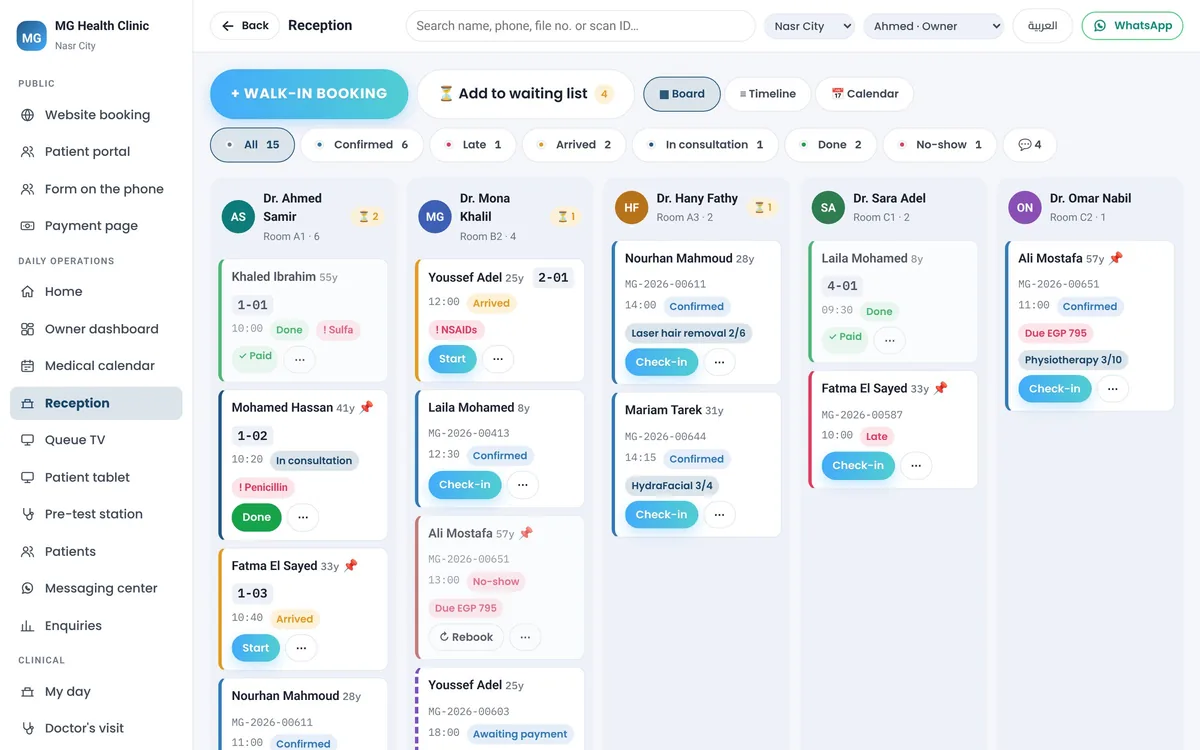
Reception staff check patients in with a single click. Their status immediately switches from scheduled to arrived across the clinic, notifying clinical assistants without phone calls or printed routing slips.
Waiting area and token call
Upon check-in, the system assigns a token number that appears on the waiting-room screen. The queue TV calls tokens clearly by consultation room as soon as the doctor marks the previous visit complete.
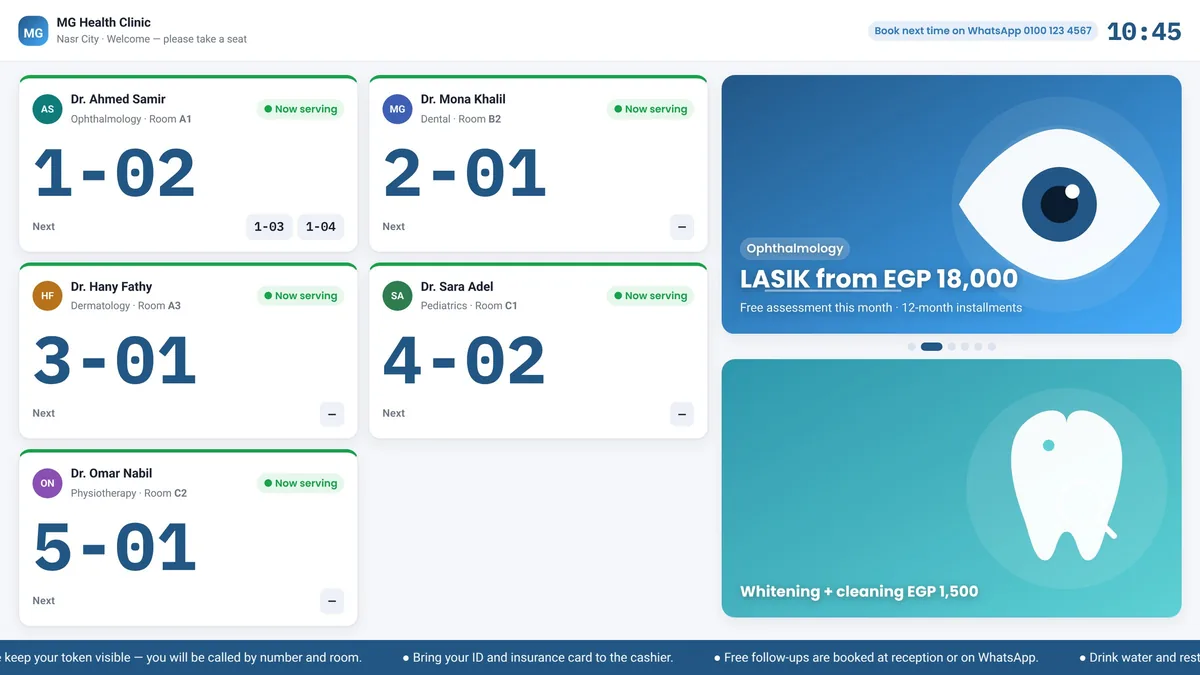
Automating queue calls removes noise and confusion from the lobby. Patients know exactly where they stand in line, and nursing staff no longer need to step into the corridor to call names aloud.
The consultation room and specialty records
Doctors open their clinical workspace on a desktop or tablet to view their live waiting queue and triage notes. Instead of generic text boxes, MG Health provides specialty-specific clinical records tailored to dental, eye, derma and laser, pediatrics, and physiotherapy practices.
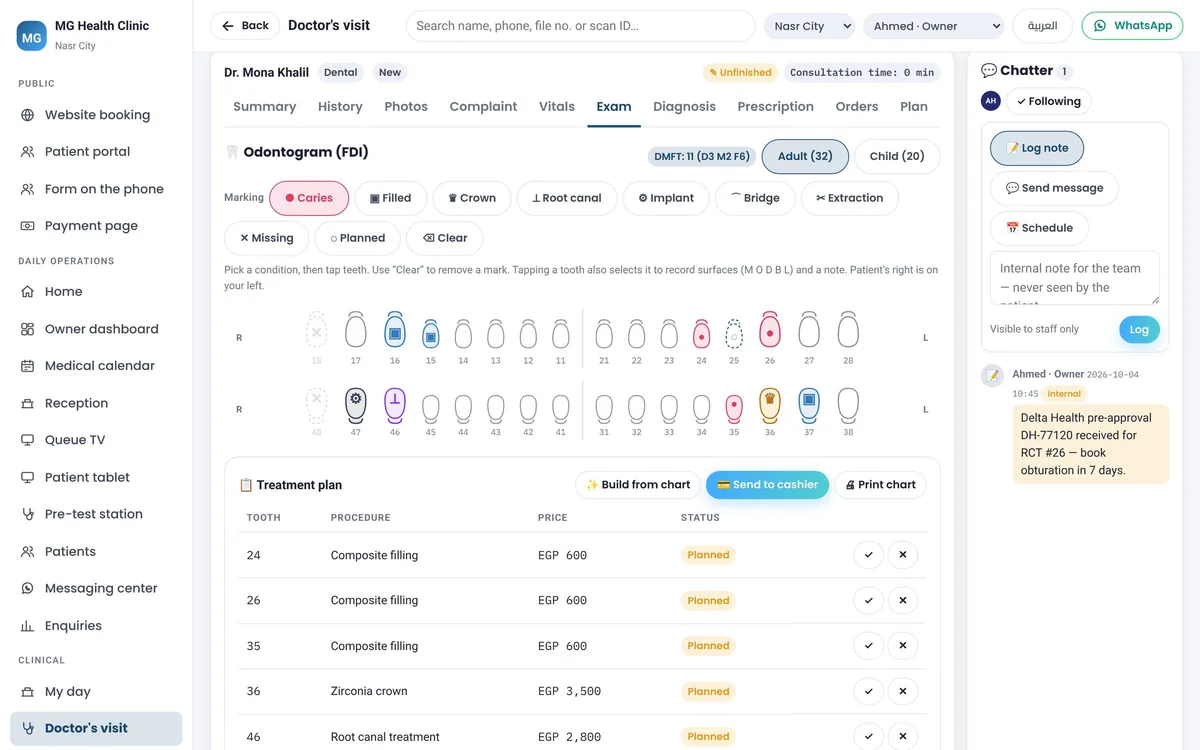
In a dental clinic, the practitioner taps teeth on an interactive odontogram to record findings and propose restorative treatments. In an ophthalmology exam, the doctor documents OD and OS refraction, monitors intraocular pressure alerts, and imports device values on one screen. The doctor writes electronic prescriptions and sends the approved treatment plan straight to the cashier with a single click.
Insurance desk and cashier billing
The cashier screen updates immediately with the doctor's approved treatment plan, eliminating handwritten notes. The system calculates insurance coverage, patient co-pay percentages, and deductible balances based on the verified policy.
Tip: Sending the treatment plan electronically from the doctor's screen to the cashier prevents overlooked add-on procedures and ensures insurance claims match the exact clinical work performed.
Patients settle co-pays or self-pay services via KNET or cash, and the cashier issues an electronic receipt that can be printed or sent instantly to the patient's phone on WhatsApp.
Evening closing and owner dashboard
At the end of the day, the cashier balances physical drawer receipts against the daily collection report in minutes. Sales, receipts, and insurance receivables automatically post to the general ledger, while clinic owners and medical directors check real-time visit volumes, revenue per practitioner, and outstanding insurer claims on the dashboard.
How MG Health helps
MG Health is built doctor-first, unifying reception, clinical documentation, and billing into one secure platform. It supports full Arabic and English with right-to-left layouts, works across desktops, tablets, and phones, and runs on regional cloud hosting or your own server.
The platform provides key tools that eliminate operational handoff bottlenecks:
- Booking and queue board: Manages every doctor's schedule, patient arrivals, allergy alerts, and deposit statuses, with self-service online booking and WhatsApp alerts.
- EMR and prescriptions: Delivers complete electronic medical records with specialty charts for dental, eye, derma/laser, pediatrics, and physiotherapy, alongside instant electronic prescribing.
- Cashier and insurance: Receives treatment plans directly from examination rooms, verifies insurance coverage and co-pays, and produces electronic receipts linked to patient payments.
- Accounting & financial reports: Posts every patient invoice, payment, and insurer claim straight into double-entry accounts with KWD calculated to 3 decimal places, KNET statement reconciliation, and bilingual reporting.
- WhatsApp messages & reminders: Sends appointment confirmations, queue notifications, and electronic invoices directly over WhatsApp to minimize no-shows and improve patient communication.
Running your clinic on a single connected workspace protects clinical time, eliminates reception bottlenecks, and provides a calm, professional experience for every patient. You can schedule a free 45-minute live demo prepared around your specialties, staff workflows, and patient journey. It gives your team the opportunity to see the reception board, specialty charts, and instant cashier reconciliation in action before deciding.
See MG Health in your business
A free 45-minute online demo, prepared around your own data. No commitment.